
Why this matters: Minis pack BMW-grade electronics into a compact chassis. From early R50/R53 hatchbacks to F56/F60 models with start‑stop and energy‑management (IBS), the correct battery type and size prevents random warnings, rough idle at stops, and short battery life. This guide shows what to buy for each Mini model, how to install and code/register replacements, and how to make them last. When you’re ready to compare, jump straight to curated searches for AGM Group 47 / H5, AGM Group 48 / H6, and AGM Group 94R / H7.
Table of Contents
- Quick Picks for Mini Owners (By Use Case)
- Top Battery Types for Minis (What to Choose & Why)
- Mini Model-Specific Buying Tips
- Mini Battery Fitment Cheat Sheet (Most-Common Sizes)
- Spec Targets: CCA, RC, and Warranty
- Best Car Battery Brands for Mini & Where-to-Buy
- Mini Car Battery Installation Guide (DIY or Shop)
- Mini Car Battery Maintenance & Longevity
- Contact Mini Customer Service & Support
- Mini Car Battery FAQs
Quick Picks for Mini Owners (By Use Case)
- Daily driver (no start‑stop, older R-series): Quality Flooded/Lead‑Acid or EFB with solid Reserve Capacity. Try Group 48/H6 options. ~$130–$220 (Flooded), $170–$260 (EFB)
- Start‑Stop Minis (most F-series): AGM is recommended; EFB is acceptable if OE was EFB. Never downgrade from AGM to flooded. See AGM H5/Group 47 and AGM H6/Group 48. ~$190–$360
- Short-trip, accessory‑heavy driving: AGM for higher charge acceptance and deep‑cycle tolerance. Browse AGM best sellers. ~$200–$350
- Cold climate (snow belt): Prioritize CCA; AGM often performs best in the cold. High‑CCA AGM H6/H7.
- Hot climate: Prefer EFB/AGM with higher RC and heat‑tolerant grids. Compare EFB.
- Track/rough roads: AGM for vibration resistance. AGM H5 picks.
Mighty Max Battery ML7-12, 12 Volt 7.2 AH SLA F1 Terminal Battery, Brand Product, Black (Pack of 1)

GOLDENMATE 12V 10Ah LiFePO4 Lithium Battery, 5000+ Deep Cycles, IP67 Waterproof Lithium Iron Phosphate Battery, Built-in BMS, Ideal for Power Wheels, Solar, Marine, Fish Finder, Ride-on Toy, Camping
ExpertPower 12V 7Ah - SLA Rechargeable 12V Battery for Ride-On Toys, Alarm System, UPS, EPS, Feeder, Exit Sign, Small 12 Volt Battery for Kids Car, Sealed Lead Acid Fire Alarm Batteries
Top Battery Types for Minis (What to Choose & Why)
| Type | Good For | Pros | Watch‑outs | Typical Price | Shop |
|---|---|---|---|---|---|
| Flooded (Lead‑Acid) | Older R50/R53 without start‑stop | Lowest cost; widely available | Lower cycle life; not for start‑stop | $120–$220 | Group 48 |
| EFB | Start‑stop on a budget | Better cycle life than flooded | Below AGM for charge acceptance | $160–$260 | H5/Group 47 EFB |
| AGM | Most F-series, cold or short‑trip use | High power, vibration‑resistant, sealed | Higher price; heavier | $190–$360 | H6/Group 48 AGM |
Mini Model-Specific Buying Tips
- R50/R53 (2002–2006) Hatch/Cooper/S: Commonly Group 48/H6 flooded or AGM depending on trim and accessories. If you’ve added audio/HVAC loads, consider AGM. ~$150–$320
- R56 (2007–2013) Hatch & R55 Clubman: Many use H6/Group 48; some trims take H5/Group 47. Check tray and hold‑down. If start‑stop is present or lots of short trips, use AGM. ~$200–$340
- R60 Countryman/R61 Paceman (2011–2016): Often H6 or H7/Group 94R on higher‑load trims. Choose AGM for best reliability. ~$210–$360
- F55/F56/F57 (2014–2023) Hardtop/5‑Door/Convertible: Commonly H5/Group 47 AGM or H6 AGM. Most cars have start‑stop—don’t downgrade. ~$200–$350
- F54 Clubman (2016–2023) & F60 Countryman (2017–2024): Typically H6 AGM; some high‑spec models may use H7 AGM. ~$220–$360
- U25 Countryman (2024+) & F66 Hardtop (2025+): Expect AGM with IBS management. Verify the exact group (H5/H6/H7) by VIN. ~$220–$380
- Cooper SE (Battery‑Electric): 12V auxiliary is usually AGM H5/H6; follow high‑voltage safety rules and consider dealer service for coding. ~$220–$360
- JCW (John Cooper Works): Higher electrical demand; stick with AGM and favor higher CCA/RC within the correct group size. ~$240–$380
Mini Battery Fitment Cheat Sheet (Most-Common Sizes)
| Model (Year) | Common BCI/EN Size | Tech | Notes | Shop |
|---|---|---|---|---|
| R50/R53 Hatch (2002–2006) | Group 48 / H6 (some H5) | Flooded or AGM | Check tray & hold‑down orientation | Group 48 choices |
| R55 Clubman & R56 Hatch (2007–2013) | H6 / Group 48 (some H5) | AGM recommended | Start‑stop trims require AGM/EFB | H6 AGM |
| R60 Countryman / R61 Paceman | H6 (some H7/94R) | AGM | AWD & high‑spec may need H7 | 94R/H7 AGM |
| F55/F56/F57 (2014–2023) | H5/47 or H6/48 | AGM | Most have start‑stop; code/register | H5/47 AGM |
| F54 Clubman (2016–2023) | H6 (some H7) | AGM | More electronics = prefer H7 | H7 AGM |
| F60 Countryman (2017–2024) | H6 or H7 | AGM | Check OE label for exact spec | H6 AGM |
| U25 Countryman (2024+), F66 Hardtop (2025+) | H5/H6/H7 (varies) | AGM | New platforms—verify via VIN | All AGM sizes |
| Cooper SE (EV) 12V Aux | H5 or H6 | AGM | Follow EV 12V procedure; consider dealer | H5 AGM |
Spec Targets: CCA, RC, and Warranty
CCA: Cold Cranking Amps
RC: Reserve Capacity
Tech: Flooded / EFB / AGM
- CCA: Meet or exceed OE. Cold climates: aim +50–100 CCA above minimum if it fits your group size.
- RC: Higher RC helps with HVAC, lights, and stop‑and‑go traffic without sagging voltage.
- Technology: If your Mini came with EFB/AGM, do not downgrade to flooded.
- Warranty: Target 36+ months free replacement (regional policies vary).
- Registration: F‑series and newer require battery registration (IBS reset) after replacement to protect alternator and preserve start‑stop behavior.
Best Car Battery Brands for Mini & Where‑to‑Buy
| Brand | Why It’s Good for Mini | Shop |
|---|---|---|
| VARTA / Bosch (AGM) | Common OE on Euro cars; strong CCA and IBS‑friendly charging | Bosch H6 AGM |
| Exide (AGM/EFB) | Stable voltage under load; good RC for start‑stop | Exide H5 AGM |
| Odyssey / NorthStar (AGM) | Premium deep‑cycle capability; handles short trips and accessories | Odyssey H6 AGM |
| Interstate / DieHard (AGM) | Strong dealer/store network; solid warranties | Shop Interstate‑type H6 |
- Amazon: Easy to compare specs and reviews; look for fresh stock and free return options.
- Local parts stores: Same‑day pickup, free testing/installation on many models.
- Mini dealer: Correct OE spec and coding service; pricier but plug‑and‑play.
How to Check Freshness & Authenticity
- Read the date code (e.g., 9/25 or alphanumeric). Prefer units < 3 months old.
- Measure open‑circuit voltage: fresh AGM ~12.7–12.9V.
- Inspect case & terminals for uniform color, no swelling, clean posts.
- Buy from reputable sellers; avoid tampered stickers or mismatched labels.
Car Battery Warranty Tips
- Get the warranty term in writing (free replacement vs. pro‑rated).
- Keep the receipt & install date with mileage noted.
- Use a maintainer if the car sits >2 weeks—maintaining SOC protects your warranty claim.
- On registered systems (IBS), code/register after replacement; some warranties require proof.

ACDelco Gold 48AGM (88864541) 36 Month Warranty AGM BCI Group 48 Battery

ACDelco Gold 94RAGM (88864542) 36 Month Warranty AGM BCI Group 94R Battery
Mighty Max Battery MM-G35 Start and Stop Car BCI Group Size 35 12V 55Ah, 100RC, 650 CCA Rechargeable AGM Car battery
Mini Car Battery Installation Guide (DIY or Shop)
- Save radio presets/ECU adaptations if desired (optional memory saver).
- Open the boot or engine bay (varies by model). Remove trim to expose the battery and IBS sensor on the negative terminal (many F‑series).
- Wear eye protection and gloves. Verify correct replacement size and terminal orientation.
- Disconnect negative (–) first (IBS side), then positive (+). Unbolt the hold‑down and lift out the old battery.
- Clean tray and terminals. Set the new battery in, align vents (if applicable), and secure the hold‑down firmly.
- Connect positive (+) first, then negative (–) to the IBS.
- Register/code the battery with a BMW/Mini‑capable scan tool (ISTA, Autel, etc.). Select battery type (AGM/EFB), capacity, and brand if prompted.
- Clear energy management faults, verify charging voltage (about 14.4V AGM peak), test start‑stop operation.
Mini Car Battery Maintenance & Longevity
- Use a smart maintainer (AGM profile) if the car sits or you take short trips.
- Keep state of charge >80%; avoid repeated deep discharges.
- Check parasitic draw if you notice overnight voltage drop (<50 mA typical at sleep for many Minis).
- Clean and tighten terminals; protect with dielectric grease where appropriate.
- For start‑stop cars: healthy AGM/EFB and proper registration are key to longevity.
Signs You Need a New Battery
- Slow cranking, especially after brief stops.
- Start‑stop deactivates frequently; energy‑saving messages appear.
- Voltage at rest <12.3V after full charge; fails load test.
- Swollen case, corrosion, or leaking.

LotFancy Battery Terminal Cleaners (2 pcs), Plus 12 pcs Battery Terminal Anti-Corrosion Fiber Washers (6 Red & 6 Green) for Car Marine RV
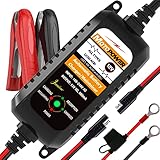
MOTOPOWER MP00205A 12V 800mA Automatic Battery Charger, Maintainer, Trickle and Desulfator
Contact Mini Customer Service & Support
- Owner’s manuals & guides: MINI Owners
- Global sites vary by region; check your local MINI website for regional warranty details.
Mini Car Battery FAQs
How long should a Mini car battery last?
AGM/EFB units in modern MINIs typically last 4–6 years in moderate climates. Lots of short trips, extreme heat/cold, or high accessory loads can reduce life to ~3–4 years; gentle highway use may extend it.
How much is a Mini car battery?
Expect roughly $180–$280 for EFB (start‑stop equipped MINIs often use EFB) and $220–$380 for AGM (common on higher‑spec models), plus installation and battery registration/coding if required.
Do I need to register/code a new battery on a Mini?
Yes—MINIs with IBS/BMS (most 2007+ models) need battery registration after replacement so the ECU charges correctly and maintains start‑stop performance.
Which battery type is best for my Mini (AGM vs. EFB vs. Flooded)?
Match or upgrade technology. If the car came with AGM, keep AGM; if it came with EFB, you may upgrade to AGM. Avoid downgrading to standard flooded on start‑stop cars.
What size battery does my Mini use?
Many MINIs use European H‑sizes (H5/L2/LN2, H6/L3/LN3). Verify by VIN/owner’s manual or measure the tray and check polarity/hold‑down before buying.
Signs my Mini battery is failing?
Slow cranking, start‑stop disabled, random electrical warnings, clock/date resets, and low state‑of‑health on a conductance test are common indicators.
Can I jump‑start a Mini safely?
Yes—use the designated under‑hood jump posts, not the battery terminals if they’re hard to access. Follow the manual’s sequence and remove cables promptly after starting.
Will a higher‑Ah battery harm my Mini?
Going slightly higher in Ah within the same physical size is usually fine if it fits and you register the battery. Never change voltage or terminal orientation.
Bottom line: