When a Ford battery is weak, you feel it fast: slow crank on cold mornings, flickering SYNC screen, random “Service Charging System” messages, start-stop refusing to work, or that dreaded jump-start in a parking lot. The right battery fixes all of that. This guide breaks down the best replacement battery for each Ford type (F-150, Explorer, Escape Hybrid, Mustang, etc.), explains AGM vs EFB vs standard flooded, and shows you which size group code (like 94R, 48/H6, 96R) you should actually buy. We’ll also cover cold-climate vs hot-climate choices, warranty strategy, how to install without losing memory, and how to stretch battery life. If you just want to browse proven Ford-fit sizes, here are direct searches you can use right now: Shop Group 94R AGM (F-150 / Expedition / Super Duty), Shop H6 / Group 48 AGM (Explorer / Edge / Escape), Shop Group 96R (Focus / Fusion / older Mustang)
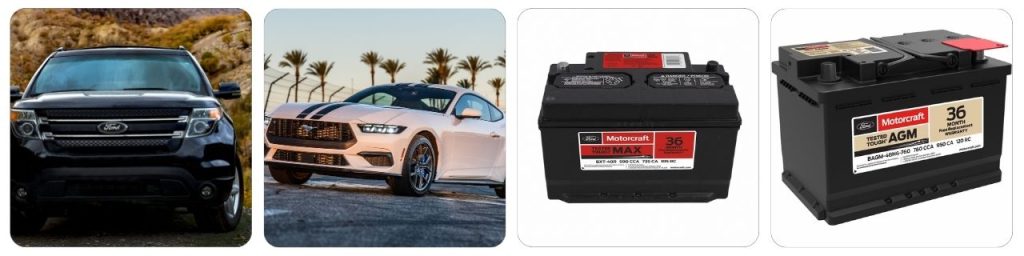
Table of Contents
- Quick Picks for Ford Owners (By Use Case)
- Top Battery Types for Fords (What to Choose & Why)
- Ford Model-Specific Buying Tips
- Ford Battery Fitment Cheat Sheet (Most-Common Sizes)
- Spec Targets: CCA, RC, and Warranty
- Best Car Battery Brands for Ford & Where-to-Buy
- Ford Battery Installation Guide (DIY or Shop)
- Ford Battery Maintenance & Longevity
- Signs You Need a New Battery
- Contact Ford Customer Service & Support
- Bottom Line
Quick Picks for Ford Owners (By Use Case)
- Daily commuter / no start-stop: A solid flooded lead-acid or EFB (Enhanced Flooded Battery) with decent Reserve Capacity (RC). If you’re in an older Focus, Fusion, Fiesta, or Mustang (non-start-stop), you’re typically looking at Group 96R or similar. ~$120–$200 flooded, $160–$240 EFB
- F-150 / Explorer / Escape with Auto Start-Stop: Use the same tech you came with: EFB (good) or AGM (best). Do not downgrade an AGM-equipped truck or SUV to a normal flooded battery — the charging system is tuned for AGM/EFB, and downgrading can kill the new battery early and trigger charging system warnings. Typical sizes are 94R AGM and 48 / H6 AGM. ~$180–$350
- High-electronics builds (platinum trim, heated/cooled seats, upgraded audio, dash cams, short-trip city driving): AGM is the move. AGM handles partial state-of-charge better and takes charge faster from the alternator. Browse top AGM batteries. ~$200–$350
- Work truck / towing / off-road (F-150, Super Duty, Bronco): Look for a high RC, vibration-resistant AGM like Group 94R or Group 65. That extra reserve acts like a buffer when you’re idling with lights, winch, bed LEDs, or a trailer brake controller. See Group 65 AGM truck batteries. ~$220–$360
- Very hot climate (Arizona / Texas summers, long idles with A/C): Heat is brutal on standard flooded batteries. EFB or AGM generally survives heat cycling better and resists plate shedding. Compare EFB automotive batteries.
- Very cold climate (snow states, sub-freezing starts): Prioritize CCA (Cold Cranking Amps). AGM usually wins in cold cranking consistency. Search high-CCA AGM and aim to meet or exceed factory CCA spec.
- Mustang owner (performance + occasional storage): You want stable voltage for ECU, ignition, and aftermarket audio even after sitting. Many Mustangs use Group 96R (older) or 94R/48 in newer trims. Look at Mustang Group 96R and Mustang 94R AGM.

Mighty Max Battery MM-H6 Start and Stop Car BCI Group Size 48 12V 70 AH, 120RC, 760 CCA Rechargeable AGM Car Battery

Key Fob Replacement Batteries for Ford/Lincoln (F150 Explorer Edge Fusion Bronco Escape Mustang Expedition Transit Ranger Maverick EcoSport MK Nautilus Corsair Navigator Lightning) Smart Remote (2-Pk)
Mighty Max Battery MM-G35 Start and Stop Car BCI Group Size 35 12V 55Ah, 100RC, 650 CCA Rechargeable AGM Car Battery
Top Battery Types for Fords (What to Choose & Why)
| Type | What It Is | Best For | Typical Ford Use | Price Range |
|---|---|---|---|---|
| Flooded / Lead-Acid | Traditional internal plates in liquid electrolyte. Cheapest option, decent cranking, lower vibration resistance. | Older Ford sedans/hatchbacks without Auto Start-Stop, light electrical load. | Older Fusion, Focus, Fiesta with a Group 96R-style battery. | ~$110–$180 |
| EFB (Enhanced Flooded Battery) | Upgraded flooded design with thicker plates and better cycling tolerance. | Vehicles with mild start-stop, or SUVs that idle with A/C, heated seats, nav, etc. | Escape / Edge / Explorer trims with start-stop but not originally AGM. | ~$160–$250 |
| AGM (Absorbent Glass Mat) | Electrolyte is held in fiberglass mats, not sloshing liquid. High CCA, great vibration resistance, handles deep cycling. | Trucks, performance cars, heavy audio systems, cold weather, lots of short trips, start-stop systems. | F-150, Expedition, Bronco, many newer Explorers and higher trims. Common groups: 94R AGM, 48/H6 AGM. | ~$190–$360 |
| Deep-Cycle / Dual-Purpose AGM | AGM tuned for long reserve output instead of pure starting amps. Often marketed for marine/RV/off-road. | Overlanding Broncos, F-150s running winches, light bars, fridges, air compressors. | Not usually OE, but popular upgrade for accessory-heavy rigs and camper setups (Group 65 / 94R style). | ~$250–$400 |
Ford Model-Specific Buying Tips
- Ford F-150 / F-Series Super Duty: Most modern F-150s and Super Duty trucks use high-capacity AGM (often Group 94R or Group 65). You want high Reserve Capacity because these trucks often run bed lights, tow packages, power inverters, trailer brake modules, etc. Look at 94R truck-rated AGM batteries. Budget ~$220–$350+
Pro tip: Trucks with dual batteries (diesel) should replace batteries as a matched pair so one weak battery doesn’t kill the new one. - Ford Explorer / Edge / Bronco / Escape: Crossovers and SUVs with Auto Start-Stop typically run EFB or AGM in Group 48 (also called H6). Start-stop cycles hammer weaker flooded batteries, so don’t cheap out. Browse Group 48 / H6 EFB or step up to H6 AGM. ~$180–$300
- Ford Mustang (V6 / GT / EcoBoost): Mustangs draw a decent standby load (security, modules, infotainment). If you store it for winter or you’ve added subs / amps, AGM is smart. Older models often take Group 96R, while newer models lean toward 94R/48 style depending on year/engine. See Group 96R Mustang batteries. ~$140–$260+
Tip: A battery tender when stored keeps Mustang parasitic draw from draining your new battery. Check tenders. - Ford Fusion / Focus / Fiesta: Budget-friendly cars usually came with smaller flooded or EFB batteries (often 96R size). These cars hate voltage drops because the PCM and TCM are sensitive; even a slightly weak battery can cause weird transmission behavior or sensor codes. Consider upgrading to high-quality EFB or AGM in the same group size. Compare AGM 96R upgrades. ~$160–$240
- Ford Escape Hybrid / Maverick Hybrid / other hybrids: You often have two energy storage systems: the high-voltage pack and a 12V support battery. That 12V battery still matters — it runs control modules, relays, computers, etc. Many hybrids spec AGM from factory for stability. Stick with AGM in the OE size, usually H5/H6/H7-style depending on platform. Usually $180–$320
Tip: Hybrids sometimes tuck the battery in the cargo area. You must use a sealed, vent-capable design (AGM) when the battery is inside the cabin. Don’t “convert” to a cheap flooded under any circumstance. - Ford Bronco / Bronco Sport / Off-road builds: Winch + light bar + fridge cooler = you want an AGM with high RC and solid vibration resistance. If you camp or air down/reinflate tires using an onboard compressor, consider dual-purpose AGM. $250–$400
Ford Battery Fitment Cheat Sheet (Most-Common Sizes)
| Ford Vehicle / Platform | Common BCI Group Size | Typical Tech | Notes | Shop Size |
|---|---|---|---|---|
| F-150 (gas, many 2015+) | 94R (a.k.a. H7) | AGM or EFB, high RC | Start-Stop trucks should stay AGM/EFB. Don’t downgrade. | Shop 94R AGM |
| Super Duty (diesel) | 65 / sometimes dual batteries | AGM preferred | Replace both at once so they age evenly. | Shop Group 65 AGM |
| Explorer / Edge / Bronco Sport / many Escapes | 48 (H6) | EFB or AGM | Auto Start-Stop = EFB minimum, AGM ideal. | Shop H6 / 48 |
| Escape Hybrid / Maverick Hybrid | H5 / H6 (varies by trim/year) | AGM | Usually trunk/cargo mounted. Must stay sealed/AGM. | Shop H5 AGM |
| Mustang (many V6/GT pre-2020) | 96R | Flooded or AGM upgrade | Performance/audio builds: go AGM for voltage stability. | Shop 96R Mustang |
| Mustang (newer GT / higher trim) | 94R / 48 | AGM | Check under-hood label. Larger case, higher CCA. | Shop 94R for Mustang |
| Fusion / Focus / Fiesta | 96R | Flooded or EFB | Start-Stop trims → EFB/AGM only, not basic flooded. | Shop 96R Focus/Fusion |
Spec Targets: CCA, RC, and Warranty
CCA: Cold Cranking Amps RC: Reserve Capacity Tech: Flooded / EFB / AGM Warranty: Free replacement period
- CCA (Cold Cranking Amps): This is how much starting current the battery can deliver in the cold. Match or exceed Ford’s factory CCA spec. If you live in very cold winters, going +50–100 CCA above stock helps ensure fast crank and clean ignition.
- RC (Reserve Capacity): RC is how long the battery can power the car’s electrical system with the engine off. High RC matters for trucks that idle with A/C on, tailgate with the radio, or run accessories like light bars or winches. If you sit in traffic with HVAC and phone chargers running, RC is your friend.
- Technology: Ford’s newer charging systems assume certain internal resistance and recharge behavior. If your SUV or truck came with EFB or AGM (especially anything with Auto Start-Stop), do not “downgrade” to a bargain flooded battery. You’ll lose performance and often shorten battery lifespan.
- Warranty: Aim for at least 36 months free replacement (or regional equivalent). A longer free-replacement period is usually more valuable than a long prorated period. Read the fine print: if the brand only offers “partial credit” after 12 months, that’s not the same as a true 3-year replacement.
- Terminal orientation / polarity: Ford commonly uses standard North American orientation, but verify. Reversed-post batteries exist in other brands (e.g. 51R in Honda). You don’t want to force cables to stretch or twist — that’s unsafe and can crack terminals.
Best Car Battery Brands for Ford & Where-to-Buy
| Brand / Line | Why People Buy It | Good For | Where to Look |
|---|---|---|---|
| AGM Premium Lines (often labeled “Platinum AGM”, “Extreme AGM”, etc.) | High CCA, high RC, sealed, vibration-resistant. Great for start-stop and trucks. | F-150, Bronco, Expedition, Explorer Platinum, audio-heavy Mustang builds. | Shop 94R AGM for F-150 |
| EFB Midrange | Cheaper than AGM but tougher than standard flooded. Handles mild start-stop. | Escape, Edge, Explorer with factory EFB. | Shop H6 / 48 EFB |
| Standard Flooded “Value” Lines | Lowest upfront cost. Fine for older small Fords without start-stop. | Focus / Fiesta / early Fusion commuters in mild climates. | Shop 96R flooded |
| Dual-Purpose / Deep-Cycle AGM | Built to handle accessories for longer (lights, fridge, winch) and still crank the engine. | Bronco overlanders, work trucks with a lot of 12V gear. | Shop Group 65 dual-purpose AGM |
- Buying online: You can usually find the exact Ford group size (94R, 48, 96R, etc.) and compare CCA/RC specs side-by-side. The part you want is often literally named after the group size. Example: “Group 94R AGM High Output” for F-150.
- Buying locally (parts store / dealer): Advantage = they’ll often test/charge the new battery for you and take your core immediately. Many will install for free on easy-access engine bays.
- Dealership battery: Usually fits perfectly and meets Ford spec, but tends to cost more. Worth it for newer vehicles still under warranty, or delicate hybrids where voltage stability matters.
- Pro Tip: Always return your old battery as a core. You get money back and you avoid disposal drama.
How to Check Freshness & Authenticity
- Date code: Every battery has a build or ship code. You want something recent, ideally within the last few months, not something that sat on a shelf for a year sulfating.
- Case condition: No bulges, cracks, or acid residue around the caps/vents. A warped case can mean it overheated or was overcharged in the past.
- Label + specs match: The sticker should match the advertised CCA and group size. If the label looks tampered or generic, walk away.
- Authentic brand packaging: Reputable sellers list the full group size (like “BCI Group 48 / H6”), not vague terms like “fits most midsize SUVs.” Vague = red flag.
Car Battery Warranty Tips
- Free replacement vs prorate: A “3-year warranty” can mean 12 months full replacement + 24 months partial credit. Read the fine print.
- Keep receipt: You’ll need proof of purchase if the battery fails early. Take a photo of the receipt and mileage at install.
- Electrical system health: If your alternator is weak or your cables are corroded, you can void the warranty by “misuse.” Clean terminals and verify charging voltage (typically ~13.5–14.7 V engine running).
- Dual-battery trucks: Replacing only one on a dual setup can get the warranty denied on the new one, because mismatched batteries cause stress. Replace in pairs.

ACDelco Gold 48AGM (88864541) 36 Month Warranty AGM BCI Group 48 Battery
Mighty Max Battery MM-G35 Start and Stop Car BCI Group Size 35 12V 55Ah, 100RC, 650 CCA Rechargeable AGM Car Battery

Interstate Batteries Automotive Battery 12V 41Ah 435CCA (Group Size 51R) SLI AGM Auto Replacement Battery for Cars, SUVs, Sedans, Trucks, Vans (MTX-51R)
Ford Car Battery Installation Guide (DIY or Shop)
- Get the right group size first: Check your current battery label (e.g. 94R, 48/H6, 96R). Buy the same physical size so it actually fits the tray and hold-down.
- Save your settings if possible: Modern Fords store radio presets, climate settings, power window calibration, and even throttle adaptives. If you want to avoid resets, use a “memory saver” in the OBD-II port or 12V outlet before disconnecting. You can find them by searching OBD-II memory saver.
- Engine off, keys out: Pop hood (or hatch for hybrids where the 12V is in back). Remove any engine covers or intake tubes blocking access.
- Disconnect negative (-) first: Loosen the negative/black terminal and move it aside so it doesn’t spring back and touch. Then disconnect positive (+).
- Remove hold-down / bracket: Most Fords use a bottom clamp or top bar. A small socket set usually does it.
- Lift battery straight up: They’re heavy. Use both hands and keep it upright — especially an older flooded battery which can vent liquid if tipped.
- Drop in the new battery: Make sure it sits flat in the tray. Reinstall the hold-down before reconnecting cables so it can’t move or vibrate.
- Reconnect positive (+) first, negative (-) last: Tight and clean. If there’s corrosion, scrub the terminals and apply dielectric grease / anti-corrosion spray. You can grab terminal protector spray to slow future buildup.
- Start the engine and check for warnings: Look for charging system messages, battery light, or start-stop disabled messages. Some newer Fords (especially with smart charging / Battery Monitoring System on the negative cable) may need a BMS reset or “battery registration” with a scan tool so the car knows it has a fresh battery. Many DIY OBD tools can do this on newer Fords — search Ford OBD-II battery reset tools.
- Recycle the old battery: Return it for a core refund or drop it at a parts store. Do not toss it in household trash — it’s hazardous waste.
Ford Car Battery Maintenance & Longevity
- Drive it long enough: Constant 5-minute trips are rough on Ford batteries because they never fully recharge. Give it a longer highway drive regularly so the alternator can top it off.
- Keep terminals clean: Corroded/clumpy terminals raise resistance, which makes the alternator work harder. That extra stress kills batteries early and can throw low-voltage trouble codes.
- Use a smart maintainer if you don’t daily drive: Mustangs, Broncos, weekend F-150s, or seasonal vehicles benefit from a float charger/tender. Look at AGM-safe maintainers to keep voltage healthy without overcharging.
- Watch parasitic drains: Dash cams, OBD telematics dongles, aftermarket amps and light bars can pull power while parked. If your Ford sits for days at the airport, unplug accessories or wire them to switched ignition power.
- Heat strategy: In very hot areas, try not to idle endlessly with A/C and big loads (lightbars, air suspension compressors, etc.) while the alternator is at low RPM. Heat + underhood radiant soak = battery life killer.
Signs You Need a New Battery
- Slow crank, especially first start of the day. The engine sounds “lazy,” like it’s turning in molasses.
- Start-Stop disabled message pops up randomly, even though nothing else seems wrong.
- Dim headlights at idle that brighten when you rev slightly.
- Random electrical gremlins: backup camera glitching, radio rebooting, stability control or ABS lights that magically go away after driving.
- Low-voltage or “System Off to Save Battery” message after parking with the radio on for only a few minutes.
- Battery is 3–5 years old (or older) in real-world heat, towing, or short-trip usage. That’s end-of-life for many daily-driven Fords.

YONHAN Battery Charger 10-Amp 12V and 24V Fully-Automatic Smart Car Battery Charger, Battery Maintainer Trickle Charger, and Battery Desulfator with Temperature Compensation

LotFancy Battery Terminal Cleaners (2 pcs), Plus 12 pcs Battery Terminal Anti-Corrosion Fiber Washers (6 Red & 6 Green) for Car Marine Battery

Tworider 12 pcs Battery terminal cleaner tool kit, battery brush, Wash Cleaning Battery Wire Brush Post Battery Cable Cleaner Dirt Corrosion Brushes Hand Tool Car Battery Cleaner Tool
Contact Ford Customer Service & Support
Ford’s official customer service can help you with warranty questions, TSBs (technical service bulletins), recalls, and in-warranty battery concerns. You can reach Ford customer service through the official
Ford Owner Support
site or your regional Ford hotline. They can also confirm whether your vehicle needs battery “registration” after replacement, especially on newer platforms with smart charging.
Ford Dealer / Service Center Locator:
Use Ford’s
dealer locator
on the official Ford website to find the nearest authorized Ford service department. An authorized Ford dealer can test your battery under load and print out a health report (CCA, state of charge, state of health).
Ford Parts / Accessories Counter:
Your local Ford dealer parts desk can give you the exact BCI group size by VIN. This is helpful if you’re between two case sizes (for example, 94R vs 48/H6) or you’re not sure if you have start-stop spec. Start with the
official dealer locator
to find a parts counter near you.
If you’re seeing charging system warnings or repeated “low battery” alerts even with a fresh battery, ask service to check the Battery Monitoring System (BMS) sensor on the negative cable. A bad sensor can trick the ECU into undercharging or overcharging the new battery.
You can also browse the official
Ford Support
resources plus trusted Ford owner forums and communities for DIY BMS resets, alternator test procedures, and start-stop troubleshooting before you pay dealer labor.
Ford Car Battery FAQs
Can I upgrade from a standard flooded battery to AGM in my Ford?
Yes. Moving from a traditional flooded (lead-acid) battery to an AGM (Absorbent Glass Mat) battery is considered an upgrade in most Ford vehicles. AGM batteries handle higher electrical loads, recharge faster, tolerate vibration better, and survive deeper discharge events (like running lights and infotainment while parked). The main rule is: flooded → AGM is okay, but you should not downgrade from AGM → basic flooded in Ford models with start-stop systems, advanced energy management, or lots of electronics (heated seats, high-output audio, etc.), because the cheaper flooded battery may not keep up.
Do I need a special battery for Auto Start-Stop in my Ford?
If your Ford has Auto Start-Stop or an intelligent charging system, you should use at least an EFB (Enhanced Flooded Battery) and ideally AGM. Those batteries are built for repeated restarts at traffic lights and high accessory load while the engine is off. Dropping in a cheaper standard flooded battery can shorten lifespan dramatically and can trigger battery management system warnings or weak restarts in traffic.
How long should a Ford car battery last?
Most Ford OEM-style batteries last about 3–5 years in normal mixed driving. Lots of short trips, heavy accessory use (A/C, defrosters, heated seats while idling), extreme summers, or harsh winters can push that down to 2–3 years. Highway-driven Fords that regularly see full alternator charging and aren’t constantly cycling start-stop can sometimes see 5+ years, especially with a high-quality AGM.
How much is a Ford car battery?
Expect roughly $100–$180 for a standard flooded lead-acid in smaller Fords, $150–$230 for EFB (common in Auto Start-Stop setups), and $180–$350 for AGM batteries used in higher-load or higher-trim models (larger SUVs, trucks with lots of electronics). Bigger case sizes with higher Cold Cranking Amps (CCA) and higher Reserve Capacity (RC) live at the top of that range.
What size battery does my Ford need?
You need to match the battery group size (H5, H6, H7, Group 48, Group 94R, etc.), terminal orientation, and the Cold Cranking Amps (CCA) rating specified by Ford. The quickest way to confirm is to read the label on your current battery or check the battery section of your Ford owner’s manual. Dropping in the wrong physical size or reversed terminals can make the cables too tight or prevent the hold-down bracket from seating.
When should I replace the battery instead of just recharging it?
If the engine cranks slowly first thing in the morning, headlights dip noticeably when you start the car, interior electronics randomly reset, or voltage keeps sagging below ~12.4V even after a long uninterrupted drive, it’s usually time to replace. Constant jump-starts and “it’ll make it one more week” thinking can leave you stranded, especially in cold weather.
Does warranty matter when choosing a Ford battery?
Yes. Look for a strong free-replacement window (often 24–36 months for quality AGM/EFB) instead of only pro-rated coverage. A confident warranty usually signals thicker internal plates, better heat resistance, and higher cycle durability — all critical for Fords with modern infotainment, power sliding doors/tailgates, cooled seats, and constant electronic standby loads.
Picking the best battery for your Ford is mostly about three things:
1) Correct group size (94R, 48/H6, 96R, etc.) so it physically fits and the posts line up.
2) Correct technology (AGM or EFB if the truck/SUV came with start-stop or heavy electronics). Never downgrade.
3) Healthy specs (meet or beat OE CCA, aim for strong Reserve Capacity, and get a real multi-year free-replacement warranty).
For trucks and start-stop SUVs, AGM is usually worth the money. For older sedans and hatchbacks, a good EFB or even a quality flooded 96R can still be the budget-friendly win. Either way, confirm fitment, install it correctly (positive first, negative last), consider a memory saver, and keep the terminals clean. Do that, and your Ford will crank strong, charge steady, and leave the random warning lights to somebody else.
ACDelco Gold 48AGM (88864541) 36 Month Warranty AGM BCI Group 48 Battery
Mighty Max Battery MM-G35 Start and Stop Car BCI Group Size 35 12V 55Ah, 100RC, 650 CCA Rechargeable AGM Car Battery