
This guide is tailored for MAN vehicles—TGE vans, TGL/TGM medium-duty, and TGS/TGX heavy-duty trucks, plus MAN buses/coaches. We explain battery tech (Flooded, EFB, AGM), common sizes, start‑stop considerations, and practical buying, installation, and maintenance tips. When you’re ready to compare, jump straight to curated searches for Group 31 AGM, DIN H7/LN4 AGM, 180Ah commercial, and EFB truck batteries.
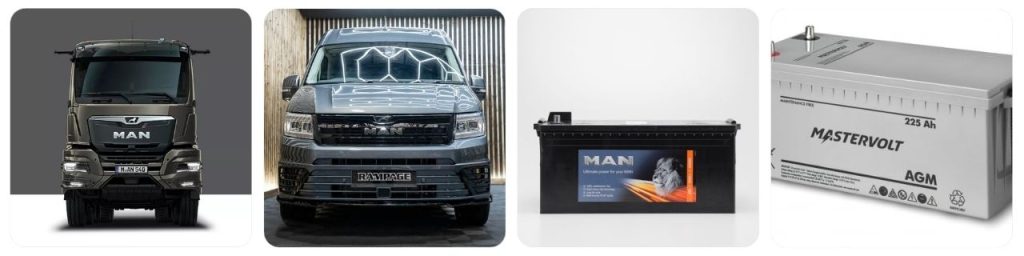
Table of Contents
- Quick Picks for MAN Owners (By Use Case)
- Top Battery Types for MANs (What to Choose & Why)
- MAN Model‑Specific Buying Tips
- MAN Battery Fitment Cheat Sheet (Most‑Common Sizes)
- Spec Targets: CCA, RC, and Warranty
- Best Car Battery Brands for MAN & Where‑to‑Buy
- MAN Battery Installation Guide (DIY or Shop)
- MAN Battery Maintenance & Longevity
- Signs You Need a New Battery
- Contact MAN Customer Service & Support
Quick Picks for MAN Owners (By Use Case)
- TGE van (no start‑stop): High‑quality Flooded or EFB in DIN H6/LN3 or H7/LN4, 70–95Ah with strong RC. Browse H6 EFB or H7 EFB. ~$160–$260 (EFB)
- TGE with start‑stop: EFB (good) or AGM (best). Do not downgrade from AGM/EFB to standard flooded. See H7 AGM. ~$200–$350
- TGL/TGM distribution trucks: Commercial AGM or SHD Flooded with high vibration resistance; many use dual 12V batteries. Compare Group 31 AGM. ~$180–$320 each
- TGS/TGX long‑haul: AGM (truck) 170–225Ah (often 2×12V in 24V system). Look at 225Ah heavy‑duty. ~$250–$450 each
- City bus/coach with frequent hotel loads: AGM preferred for deep‑cycle tolerance and vibration resistance. See AGM bus batteries. ~$280–$500 each
- Cold climate (mountain routes): Highest feasible CCA, AGM excels. High‑CCA AGM picks.
- Hot climate (stop‑and‑go): Favor EFB/AGM with high RC and heat‑tolerant grids. Compare EFB.

Mighty Max Battery MM-H7 Start and Stop Car BCI Group Size 94R 12V 80AH, 140RC, 850 CCA Rechargeable AGM Car Battery

UPLUS BCI Group 48 Car Battery, AGM-L70-M Maintenance Free 12V 70Ah Premium AGM Batteries H6 L3 Automotive Battery, 760CCA, 120RC

Interstate Batteries Group 24 Car Battery Replacement (M-24) 12V, 550 CCA, 18 Month Warranty, Replacement Automotive Battery for Cars and Trucks
Top Battery Types for MANs (What to Choose & Why)
| Type | Best For | Upsides | Trade‑offs | Typical Price |
|---|---|---|---|---|
| Flooded SHD (Super Heavy Duty) | Older fleets, mild hotel loads | Lowest cost, widely available | Lower cycle life, more acid stratification | $140–$230 each; browse SHD options |
| EFB (Enhanced Flooded) | TGE start‑stop, urban delivery | Better cycle life and charge acceptance vs flooded | Costs more than flooded | $160–$280; see EFB picks |
| AGM (Absorbent Glass Mat) – Truck | Long‑haul, buses, high hotel loads, cold climates | High CCA, deep‑cycle tolerant, spill‑proof, vibration‑resistant | Highest price; needs compatible charging | $200–$450; compare Group 31 AGM |
MAN Model‑Specific Buying Tips
- TGE (2017+): Typically DIN H6/LN3 (70–80Ah) or H7/LN4 (80–95Ah). Start‑stop models need EFB or AGM. Budget $180–$350. Shop H7 AGM / H6 EFB.
- TGL/TGM (medium‑duty): Many trims use dual 12V batteries (often Group 31 or DIN commercial, 110–140Ah). Choose SHD Flooded (value) or AGM (premium). Estimate $360–$640 per pair. See Group 31.
- TGS/TGX (heavy‑duty): Commonly 24V system (2×12V) with 170–225Ah per battery. Long‑haul with hotel loads: pick AGM. Budget $500–$900 per pair. Compare 225Ah.
- MAN Bus/Coach (Lion’s City/Coach): Prioritize RC and vibration resistance. AGM recommended. Expect $600–$1,000 per pair. Browse bus AGM.
- Aux/Hotel batteries: If you run fridges, HVAC, lifts, telematics overnight, consider a separate deep‑cycle AGM bank and an isolator/DC‑DC charger. Shop DC‑DC chargers.
MAN Battery Fitment Cheat Sheet (Most‑Common Sizes)
| Model | Common Size(s) | Typical Ah / CCA | Notes |
|---|---|---|---|
| TGE (2.0 TDI) | DIN H6/LN3 or H7/LN4 (EFB/AGM) | 70–95Ah / 680–850 CCA | Start‑stop requires EFB/AGM; verify terminal orientation |
| TGL / TGM | 2× Group 31 (or DIN commercial equivalent) | 110–140Ah each / 800–1000 CCA | Check hold‑down and tray length before purchase |
| TGS / TGX | 2× 12V commercial (170–225Ah each) | 1000–1400 CCA each | Hotel loads favor AGM; confirm 24V cabling/insulation |
| MAN Bus/Coach | 2× commercial AGM | 170–225Ah each / High CCA | Deep‑cycle tolerance and vibration resistance are key |
Spec Targets: CCA, RC, and Warranty
CCA: Cold Cranking Amps RC: Reserve Capacity Tech: Flooded / EFB / AGM
- CCA: Meet or exceed OE CCA. Cold routes benefit from +100–150 CCA above minimum.
- RC: Higher RC supports telematics, HVAC, and lifts during idling/overnight.
- Technology: If the truck came with EFB/AGM, do not downgrade.
- Vibration rating: For rough roads and construction, prioritize vibration‑resistant designs (AGM/SHD).
- Warranty: Target 24–36 months commercial free replacement (region‑dependent). Keep proof of proper charging.
Best Car Battery Brands for MAN & Where‑to‑Buy
| Brand | Strengths | Try |
|---|---|---|
| Varta / Clarios | OEM for many EU trucks; strong AGM/EFB lines | Varta truck |
| Bosch | Reliable SHD and AGM commercial batteries | Bosch commercial |
| Exide | Broad EU coverage, good value SHD/EFB | Exide truck |
| Odyssey (EnerSys) | Premium AGM, high CCA, deep‑cycle capable | Odyssey G31 AGM |
| Optima | Rugged spiral‑cell AGM, excellent vibration resistance | Optima G31 |
- Dealers/Parts counters: Great for VIN‑verified fitment and returns.
- Online marketplaces: Largest selection; check seller ratings and manufacture dates.
- Fleet suppliers: Often best on bulk pricing and on‑site service.
How to Check Freshness & Authenticity
- Date code: Prefer batteries < 6 months from manufacture. Many use letter (month) + digit (year).
- Seals & labels: Factory shrink‑wrap intact; no acid stains, no bulging case.
- Open‑circuit voltage: 12.6–12.8V for fully charged AGM; avoid anything < 12.4V on arrival.
- QR/serial: Verify with brand portal when available.
Car Battery Warranty Tips
- Keep purchase receipt and installation log (date, mileage, voltage).
- Document charging system test results (alternator/regulator) at install.
- Record any parasitic draw diagnostics; misuse can void coverage.
- Follow storage/maintenance instructions for seasonal fleets.

ACDelco Gold 48AGM (88864541) 36 Month Warranty AGM BCI Group 48 Battery

ACDelco Gold 94RAGM (88864542) 36 Month Warranty AGM BCI Group 94R Battery

Renogy 12V 70Ah AGM Car Battery H6, Group 48 Start and Stop Automotive Battery with 720 CCA, 120RC, Reliable Power for Cars, SUVs, Trucks, and Marine Starting
MAN Car Battery Installation Guide (DIY or Shop)
- Save radio/settings if needed; park safely, apply parking brake, wear PPE.
- Locate the battery box (cab step, frame rail, or engine bay for TGE). Remove covers and brackets.
- Connect a memory saver if the vehicle is sensitive to power loss (TGE with start‑stop).
- Turn ignition off. Disconnect negative (-) first, then positive (+). Note any sensor leads.
- Remove hold‑downs; lift out the battery (teams/lifting aids for heavy commercial units).
- Clean the tray and clamps. Treat corrosion. Check ventilation tubes if equipped.
- Place the new battery, confirm polarity/fit. Install hold‑downs to spec (no wobble).
- Reconnect positive (+) first, then negative (-). Tighten to torque spec.
- If AGM/EFB on start‑stop TGE: register/coding with scan tool so the ECU knows the new battery type/capacity.
- Start engine; verify voltage 14.0–14.7V (AGM at colder temps). Clear any fault codes and check start‑stop operation.
MAN Car Battery Maintenance & Longevity
- Run a weekly battery health check on high‑duty trucks; log voltage and load‑test results.
- Top up charge on depot days with a smart charger—especially for trucks with hotel loads. See AGM‑safe smart chargers.
- Inspect cables, grounds, and frame‑to‑cab straps for corrosion or fraying.
- Secure batteries firmly; vibration kills capacity.
- For multi‑battery banks, replace in pairs and match age/brand when possible.
- Use a battery monitor (shunt‑type) to track SOC/SOH on long‑haul rigs.
Signs You Need a New Battery
- Slow cranking, especially after short stops or overnight hotel load use.
- Start‑stop disabled messages or frequent restarts.
- Visible case swelling, leakage, or rotten‑egg odor.
- Repeated low‑voltage alerts even with normal alternator output.

LotFancy Battery Terminal Cleaners (2 pcs), Plus 12 pcs Battery Terminal Anti-Corrosion Fiber Washers (6 Red & 6 Green) for Car Marine RV
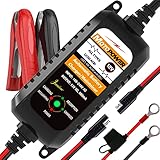
MOTOPOWER MP00205A 12V 800mA Automatic Battery Charger, Maintainer, Trickle and Desulfator
Contact MAN Customer Service & Support
- Official website: man.eu
- Service & Parts: Service overview
- Dealer/Service Locator: Find a MAN location
- Owner’s manuals & documentation: Downloads
MAN Car Battery FAQs
Which battery technology is best for MAN vehicles with start-stop or heavy electrical loads?
AGM (best) or EFB (good). Do not downgrade from AGM/EFB to standard flooded if your MAN uses start-stop or has high parasitic loads.
How do I find the correct battery size for my MAN?
Check the existing battery label, the owner’s manual, or a VIN lookup. Match case size, terminal layout, and hold-down style before buying.
Do MAN vehicles require battery registration after replacement?
Some newer models with intelligent charging benefit from a battery reset/registration via scan tool to calibrate charge strategy and prolong life.
Can I upgrade from EFB to AGM in my MAN?
Yes—AGM is a valid upgrade for start-stop and high-demand use. Just match size and specs, and perform registration where applicable.
What specs matter most for MAN batteries?
Meet or exceed OE Cold Cranking Amps (CCA), aim for high Reserve Capacity (RC), and choose a reputable brand with a strong warranty (ideally 36+ months).
How long should a MAN car battery last?
Typically 3–5 years. Intensive urban driving, extreme temperatures, and frequent start-stop cycles may shorten this to 2–4 years; highway-heavy use with periodic maintenance charging can extend life.
How much is a MAN car battery?
Approx. $140–$260 for EFB and $200–$400 for AGM, with larger commercial-grade cases trending higher. Prices vary by region, brand, and warranty length.
What are signs my MAN battery is failing?
Slow cranking, dim cluster lighting, intermittent start-stop operation, frequent jump-starts, and resting voltage repeatedly below ~12.4V.
How can I maximize battery life in a MAN?
Keep terminals clean and tight, secure the hold-down, drive longer trips periodically, and use an AGM-safe smart maintainer during storage or short-trip usage patterns.
Is higher CCA always better for MAN vehicles?
Higher CCA helps cold starts, but balance it with correct case size, RC, and the required battery technology (EFB/AGM) for your charging system.
Bottom line:
For TGE, choose EFB/AGM in H6/H7 with proper ECU registration. For TGL/TGM, dual Group 31 SHD (value) or AGM (premium). For TGS/TGX and buses, prioritize AGM 170–225Ah per battery with high CCA and vibration resistance. Always verify by VIN, buy fresh stock, and match tech to duty cycle.
ACDelco Gold 48AGM (88864541) 36 Month Warranty AGM BCI Group 48 Battery
ACDelco Gold 94RAGM (88864542) 36 Month Warranty AGM BCI Group 94R Battery